You have finished your degree, you are ready to start applying, and then you hit the first wall — building your resume. You open ten different templates online, each one looking completely different, and you have no idea which format will actually get you shortlisted. Sound familiar?
Here is the truth most freshers learn the hard way. The biggest companies in India — TCS, Infosys, Wipro, Accenture and hundreds of startups — rarely have a human read your resume first. A software does. And if your resume format confuses that software, your application gets rejected before any recruiter ever sees your name.
The good news is that the right resume format for freshers in India is not complicated. Once you understand what recruiters and screening systems are looking for, you can build a clean, professional resume that gets noticed. This guide walks you through the exact format, section order, and formatting rules you need in 2026 — even if you have zero work experience.
1. Why Your Resume Format Matters More Than You Think
Most freshers obsess over what to write but ignore how it is structured. That is a mistake. Your format decides whether your content is even read in the first place.
Recruiters at top Indian companies spend roughly 6 to 10 seconds on a first scan of a resume. In those few seconds, they are not reading every word — they are looking for clear sections, relevant skills, and a layout that feels easy to follow. A cluttered or oddly designed resume signals inexperience before you have said anything.
There is also a second gatekeeper: the Applicant Tracking System (ATS). Around 90% of large Indian organisations use ATS software to filter resumes before a human review. The system scans your resume top to bottom, left to right, and pulls out details like your name, skills, education, and keywords. If your format breaks that scanning process, your resume can get scrambled or rejected automatically — no matter how strong your actual qualifications are.
So your format has one job: make your strengths instantly clear to both a machine and a busy human. Everything in this guide is built around that single goal.
2. The Three Resume Formats — And Which One Freshers Should Use
There are three common resume formats, and choosing the right one depends on what you have to show. Here is a simple breakdown.
Format | Best For | What It Highlights |
Reverse-Chronological | Freshers with internships, projects, or any part-time work | Education and recent experience, listed newest first |
Functional (Skills-based) | Freshers with no work experience at all | Skills, projects, and abilities over work history |
Combination | Freshers with strong projects plus an internship or two | A balance of skills and experience together |
For most freshers in India, a reverse-chronological format is the safest and most recommended choice. It is the layout that recruiters expect, and it is the most ATS-friendly because the structure is predictable. You list your most recent and relevant items first, working backwards.
If you have genuinely no internships, projects, or part-time work, a functional format can shift the focus onto your skills. But be careful — many recruiters are slightly wary of pure functional resumes because they can look like you are hiding a lack of experience. In that case, a combination format that leads with skills but still includes your academic projects is usually a smarter middle ground.
The right resume format for freshers in India is rarely about being creative. It is about being clear, expected, and easy to scan.
3. The Ideal Section Order for a Fresher Resume
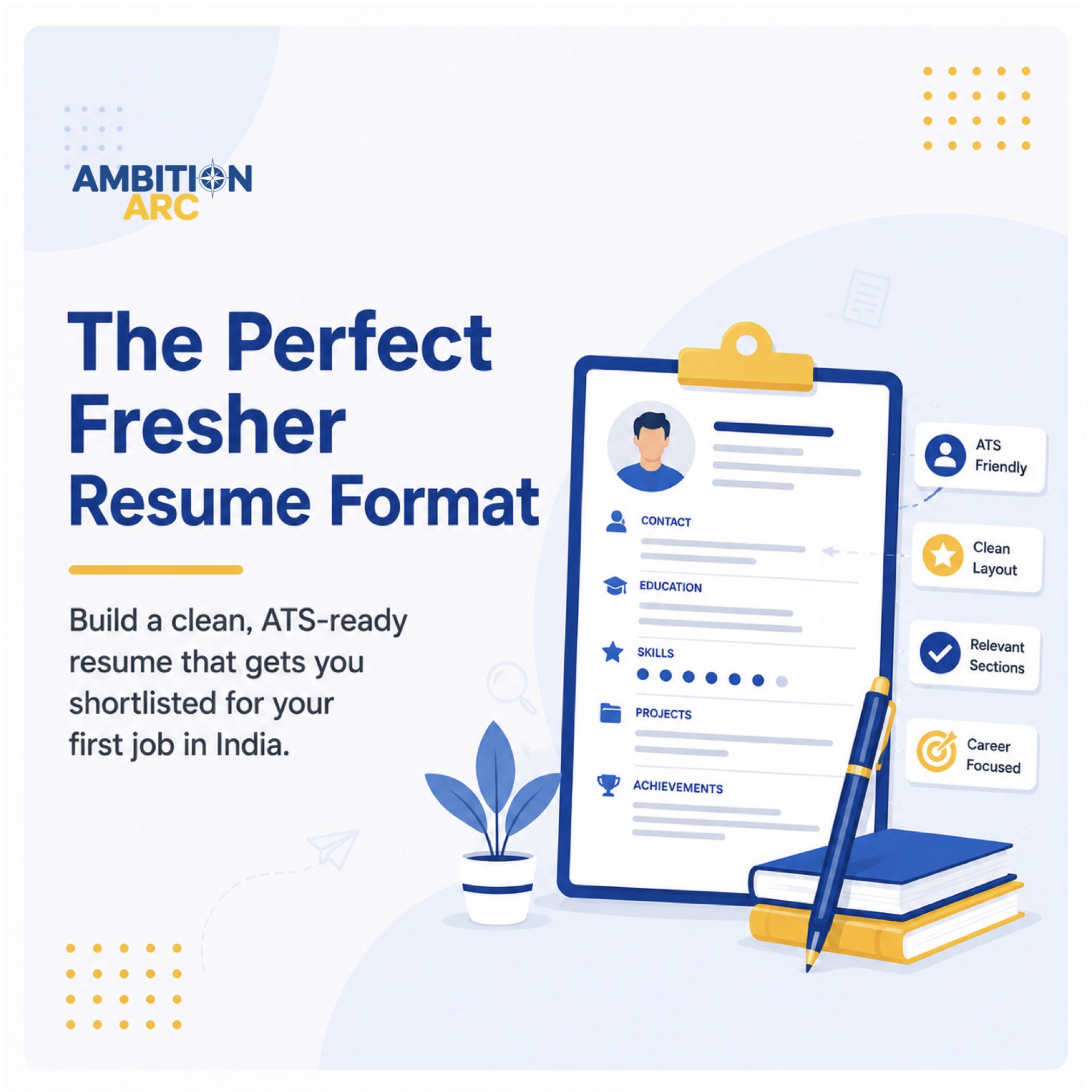
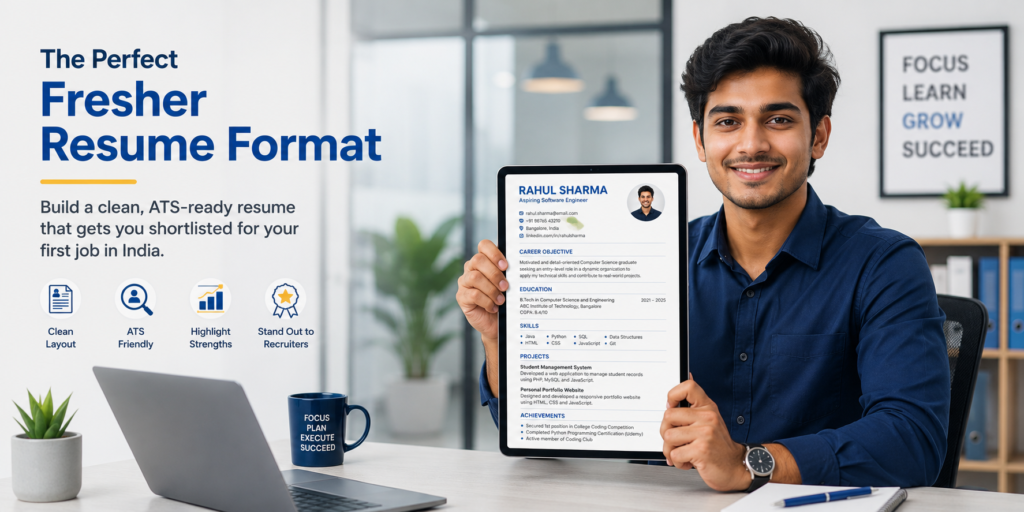
Order matters. Since you do not have years of work history, you need to lead with what proves your potential. Here is the section order that works best for freshers.
A. Contact Information
Place this at the very top. Keep it simple and complete:
- Full name (slightly larger font, but no fancy logos or photos)
- Phone number and a professional email address (avoid nicknames like coolguy_99)
- City and state (full address is not needed)
- LinkedIn URL — for tech and corporate roles in 2026, a missing LinkedIn link is a red flag
- GitHub or portfolio link if you are in tech, design, or content
B. Professional Summary or Objective
Write 2–3 lines that tell the recruiter who you are and what you bring. Skip the tired “looking for a challenging role” line — it wastes prime space. Instead, mention your degree, your top skills, and the kind of role you want. For example: “Computer Science graduate skilled in Python and SQL, with hands-on project experience building web applications, seeking a software developer role.”
C. Education
For freshers, education usually comes before experience. List your highest qualification first. Include your degree, college name, year of completion, and your CGPA or percentage if it is strong (generally above 7.0 CGPA or 65%). If your scores are average, you can leave them out and let your projects do the talking.
D. Technical Skills
Group your skills logically — for example, separate Programming Languages, Tools, and Soft Skills. This helps both ATS parsing and recruiter readability. Match these skills to the keywords in the job description wherever they genuinely apply to you.
E. Projects, Internships and Certifications
This is where freshers win or lose. Since you lack full-time experience, your academic projects, internships, and certifications carry the weight. Add live links to GitHub or deployed projects where possible — they signal real, hands-on work.
4. Formatting Rules That Keep Your Resume ATS-Friendly
A great structure can still fail if the formatting confuses the software. Follow these rules to stay ATS-friendly while looking professional.
- Stick to a single-column layout. Two-column and sidebar designs look stylish, but ATS reads them out of order — your skills can get mixed with your education and dates can land in the wrong place.
- Use standard fonts. Calibri, Arial, or similar clean fonts at 10–12pt are easy for both humans and machines to read. Avoid decorative or condensed fonts.
- Use standard section headings. Write “Education”, “Skills”, and “Projects” — not creative labels like “My Journey”. ATS recognises standard headings.
- Avoid photos, icons, and graphics. A passport photo or logo header may look attractive but is invisible to ATS and adds no value in most Indian roles.
- Keep it to one page. For freshers, one clean page is ideal. Every line should earn its place.
- Save and send as PDF unless the application specifically asks for a Word document — PDF preserves your formatting across devices.
These small choices make a big difference. A resume that follows them passes the screening stage far more often than a heavily designed one.
5. Common Resume Mistakes Freshers Make
Even strong candidates lose out because of avoidable errors. Watch out for these.
- Listing responsibilities instead of achievements. Saying “responsible for testing” is weak. Instead write the outcome: “Tested 3 web modules and reported 15+ bugs, improving release stability.” Achievement-focused lines are one of the strongest signals to Indian recruiters.
- Using one generic resume for every job. Tailor your skills and summary to match each job description. The keywords you mirror help you clear ATS filters.
- Adding a long objective full of buzzwords. Keep it short, specific, and results-focused.
- Stuffing irrelevant details. Your Class 10 marks, hobbies like “watching movies”, or a declaration with your signature are mostly outdated for modern resumes. Cut the clutter.
- Typos and inconsistent formatting. Mismatched fonts, uneven spacing, or spelling errors signal carelessness. Proofread twice, then ask a friend to check.
Fixing these takes very little time, but it can be the difference between a callback and silence.
6. A Quick Pre-Submit Checklist
Before you send your resume for any campus placement or off-campus drive, run through this fast check:
- Is it one page and a single column?
- Are the section headings standard and easy to scan?
- Have you matched keywords from the job description?
- Did you lead with achievements and numbers, not vague duties?
- Is your contact information complete, including LinkedIn?
- Have you saved it as a PDF with a clear file name like Firstname_Lastname_Resume?
If you can tick every box, your resume is ready to compete.
Conclusion
Building your first resume can feel overwhelming, but the right approach makes it simple. The best resume format for freshers in India in 2026 is clean, single-column, reverse-chronological, and built to pass both ATS software and a quick human scan. Focus on clear sections, real projects, and achievements backed by numbers.
You now know exactly what format to use, how to order your sections, and which mistakes to avoid. With this foundation, you can build a resume that actually gets you shortlisted — and gives you the confidence to apply with purpose.
To learn more about resume building, interview preparation, and career growth, visit Ambitionarc.com today and take the next step toward becoming job-ready.
FAQs
Q: Should freshers send their resume as a PDF or Word file?
A: Send a PDF in most cases, because it keeps your formatting consistent across devices and ATS systems. Only use a Word document if the company or job portal specifically asks for one. Always name the file clearly, like Firstname_Lastname_Resume.pdf.
Q: Is it okay to add a photo on a resume for Indian jobs?
A: For most corporate and IT roles in India, skip the photo. It adds no value, takes up space, and is invisible to ATS software. Photos are only expected in a few fields like aviation, hospitality, or modelling.
Q: How long should a fresher resume be?
A: One page is the gold standard for freshers. You simply do not have enough experience to justify two pages, and recruiters prefer a tight, focused document. Keep every line relevant.
Q: What CGPA or percentage should I include on my resume?
A: Include your CGPA or percentage if it is strong — generally above 7.0 CGPA or around 65% and above. If your score is on the lower side, you can leave it out and let your projects, internships, and skills carry the application.
Q: Do I still need a “Declaration” and signature at the bottom?
A: No, the old-style declaration with “I hereby declare…” and a signature is outdated for modern resumes. It wastes space that could highlight your skills. You can safely remove it.
Q: What if I have absolutely no internship or work experience?
A: Lead with your academic projects, certifications, and technical skills instead. A functional or combination format works well here. Even a strong final-year project with a GitHub link can prove your ability to an employer.
Q: How do I know if my resume is ATS-friendly?
A: Use a single-column layout, standard fonts, and standard section headings, and avoid images or tables for core content. You can also run your resume through a free online ATS checker to see how well it parses before applying.
Q: Should I list soft skills like “teamwork” and “communication”?
A: You can, but keep them brief and back them up with proof elsewhere in the resume. A line about leading a college fest team shows teamwork better than just listing the word. Recruiters trust evidence over labels.
Q: How many skills should a fresher list?
A: Aim for a focused set of around 8–12 relevant skills, grouped logically. Listing 30 random skills looks like padding and dilutes your strengths. Prioritise the ones that match the jobs you are targeting.
Q: Can I use the same resume for both campus placements and off-campus drives?
A: You can use one strong base resume, but tailor the summary and skills to match each specific job description. Even small keyword tweaks improve your chances of clearing ATS filters. Treat your resume as a living document, not a one-time file.
Q: Is a colourful, designer template a good idea to stand out?
A: Usually not for Indian fresher roles. Heavy colours, columns, and graphics often break ATS parsing and can look unprofessional. Stand out through clear achievements and clean formatting instead of flashy design.
Q: How often should I update my resume as a fresher?
A: Update it every time you complete a new project, internship, certification, or course. Keeping it current means you are always ready to apply the moment a good opportunity appears.
About the Author

Ambareesh Singh
Founder of Ambition Arc | Career Mentor | Resume Expert | MBA (Finance & Marketing)
With 12+ years of experience in the EdTech and FinTech industries and an MBA in Finance & Marketing, I have helped thousands of professionals advance their careers. Having interviewed 5,000+ candidates, I understand what recruiters look for in top talent. Through Ambition Arc, I share practical insights on resumes, interviews, job search strategies, and career growth to help freshers, professionals, and international students succeed.