You are ready to apply for your first job. You open a job portal, click “Apply Now,” and then it hits you — the resume field stares back at you like a blank page you have no idea how to fill. You have never had a full-time job. No company name. No job title. No work history section to speak of.
If this sounds familiar, you are not alone. Millions of fresh graduates, college students, and career starters across India face the exact same situation every year. The good news? Not having work experience does not mean not having anything to show. It just means you need to know what to highlight and how to present it.
This guide will walk you through exactly how to write a resume with no work experience — from choosing the right format to filling every section with content that actually gets you shortlisted. By the end, you will have a clear plan to build a resume that works for you, even if your work history is currently empty.
Table of Contents
ToggleUnderstand What a Resume Is Really For
Before you start writing, it helps to understand what a resume is actually supposed to do. A resume is not just a list of your past jobs. It is a marketing document. Its job is to show a recruiter that you have the potential, the skills, and the mindset to succeed in the role.
When a recruiter looks at your resume, they are asking one question: “Can this person do the job?” Your work history is just one way to answer that question. But there are many other ways — and that is exactly what this blog will show you.
Recruiters spend an average of 6–8 seconds scanning a resume before deciding whether to read it properly. That means your resume needs to be clean, focused, and immediately easy to read. Format and structure matter just as much as content.
Choose the Right Resume Format
Most people default to the chronological resume format, which lists your work experience from most recent to oldest. If you have no work experience, this format will leave your resume looking empty. Instead, consider these two formats:
Functional Resume Format
A functional resume focuses on your skills and abilities rather than your work timeline. It puts your relevant skills front and centre, followed by a brief education and project section. This is a good choice if you have strong technical or transferable skills to show.
Combination Resume Format
A combination resume blends the best of both formats. It highlights your key skills at the top and then lists your education, projects, and any part-time or volunteer experience below. This is the most recommended format for freshers and students because it gives you flexibility without hiding anything.
Resume Format | Best For | Focuses On |
Chronological | Professionals with 2+ years of experience | Work history timeline |
Functional | Career switchers, skill-heavy profiles | Skills and competencies |
Combination | Freshers, students, first-time job seekers | Skills + education + projects |
ATS-Friendly | All job seekers applying online | Clean formatting, keywords |
Pick the format that best suits where you are right now. There is no single “right” answer — only the one that works for your situation.
Write a Strong Resume Summary
The resume summary (also called a professional summary or objective) sits at the very top of your resume, right below your name and contact details. It is 2–4 sentences that tell the recruiter who you are, what you bring to the table, and what kind of role you are looking for.
For someone with no work experience, this section is critical. It is your chance to make a strong first impression before the recruiter even scrolls down.
What to Include in Your Summary
- Your degree or current area of study
- Your strongest 2–3 skills
- The type of role or industry you are targeting
- One line about your goal or what you want to contribute
Example Summary (No Experience)
“A motivated BBA graduate with strong skills in digital marketing, content writing, and data analysis. Completed a certified course in Google Analytics and created social media campaigns for college events. Eager to apply practical skills in a marketing or communications role.”
Notice how this summary does not say “I have no experience.” Instead, it focuses entirely on what the candidate does have. That shift in mindset makes all the difference.
Make the Most of Your Education Section
When you have no work history, your education section becomes one of your strongest assets. Do not treat it as just a line that says your degree and college name. Go deeper.
Here is what you can add to your education section:
- Relevant coursework — List 4–6 subjects directly related to the job (e.g., “Digital Marketing, Consumer Behaviour, Business Communication”)
- Academic achievements — Mention your GPA, rank, or any academic awards if strong
- College projects — Briefly describe 1–2 major projects you worked on during your degree
- Relevant certifications — Include any online certifications you earned alongside your studies
For example, if you are applying for an HR role and you studied HR Management as part of your degree, list it. If you completed a project on employee engagement during your MBA, include it. These details show the recruiter that your education is directly relevant to the role.
Add Projects, Internships, and Freelance Work
This is where most students underestimate themselves. You may not have a formal “job,” but chances are you have done something that counts as real experience.
Ask yourself:
- Did you do a college project that involved research, analysis, coding, design, or presentation?
- Did you complete an internship — even a short one, unpaid, or virtual?
- Did you freelance — create a logo for a friend’s business, write articles, manage social media?
- Did you volunteer for an event, NGO, or college committee?
- Did you participate in competitions, hackathons, or case study challenges?
All of these belong on your resume. Each one shows initiative, practical skill, and willingness to work.
How to Write a Project Entry
Use this simple format:
Project Name | Duration or Year
- Briefly describe what the project was about (1 sentence)
- Mention your specific role or contribution
- State the result or outcome if possible
Example:
Social Media Campaign – College Annual Fest | March 2024
- Designed and managed Instagram content for a 3-day college fest reaching 5,000+ followers
- Increased event page engagement by 40% through consistent posting and reel creation
- Collaborated with a team of 4 to create branded visual content
That is a genuinely impressive entry — and it required zero years of full-time employment.
Build a Solid Skills Section
Your skills section can compensate enormously for a lack of work history — but only if it is done right. Avoid vague, generic skills like “good communication” or “team player” without any context. Instead, split your skills into categories.
Technical Skills (Hard Skills)
These are specific, learnable abilities — the kind you can prove:
- Microsoft Office (Word, Excel, PowerPoint)
- Canva or Adobe Photoshop (graphic design)
- Python, SQL, or Excel (data analysis)
- WordPress or SEO tools (digital marketing)
- Tally or QuickBooks (accounting and finance)
List only skills you are actually comfortable using. Recruiters may ask about any skill you mention.
Soft Skills (With Context)
Soft skills are powerful, but only when backed with an example. Instead of just writing “leadership,” write:
- Leadership — Led a team of 6 during the college cultural committee, coordinating events for 500+ students
That one line tells a much better story than a single word ever could.
Add Certifications and Online Courses
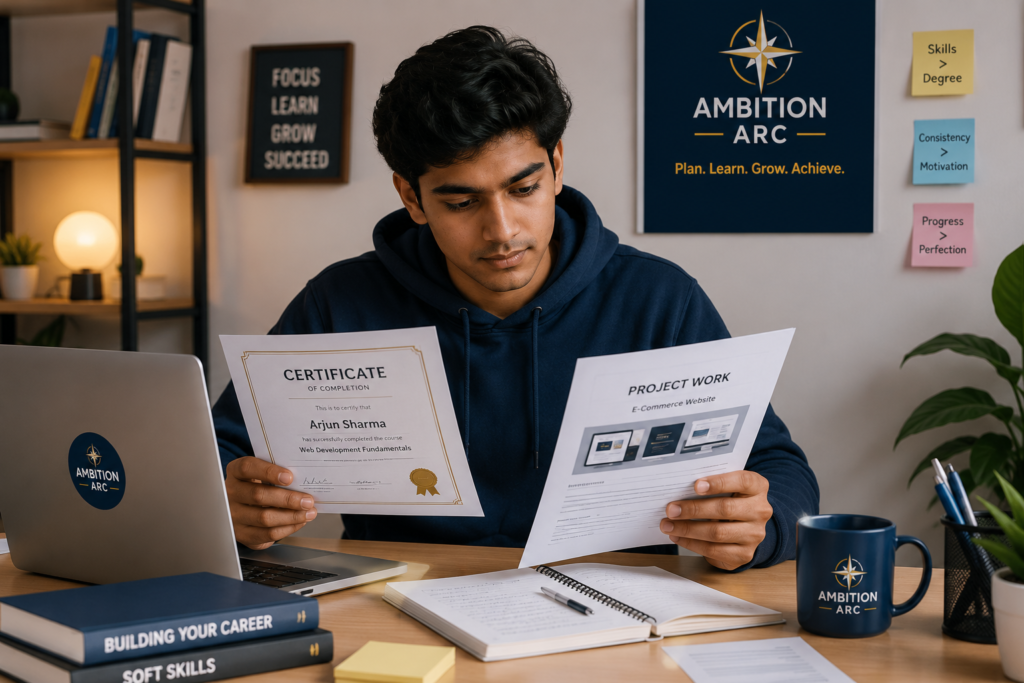
One of the best things you can do as a fresher is build your skills through certifications — and then put them on your resume. Certifications show that you are proactive, curious, and serious about your career.
Recruiters look positively at candidates who have invested time in learning, even outside of college. Here are some examples of certifications that add real value:
- Google Digital Marketing Certificate
- HubSpot Content Marketing Certification
- LinkedIn Learning – Excel for Beginners
- Coursera – Data Analysis with Python
- NASSCOM – Future Skills courses
- Meta Blueprint – Social Media Marketing
Add each certification with the platform name and the year of completion. If you do not have any certifications yet, this is the right time to start. Many platforms offer free or low-cost courses that can significantly boost your resume.
Tailor Your Resume for Every Job Application
This is the step that most freshers skip — and it is one of the most important ones. A generic resume sent to 50 companies is far less effective than a tailored resume sent to 10.
Here is how to tailor your resume:
- Read the job description carefully — identify the skills, qualifications, and responsibilities mentioned
- Match your language — use the same words the job description uses (e.g., if it says “content strategy,” use that exact phrase)
- Move relevant sections higher — if the job values projects, put your project section above your skills section
- Update your summary — rewrite your summary to reflect the specific role you are applying for
- Check for ATS compatibility — many companies use Applicant Tracking Systems to filter resumes. Use simple fonts, standard headings, and avoid tables or graphics in ATS versions
Tailoring your resume takes an extra 15–20 minutes per application. But that 20 minutes can be the difference between getting shortlisted and getting ignored.
Format and Design: Keep It Clean and Professional
The way your resume looks is just as important as what it says. A cluttered or poorly formatted resume will be dismissed even if the content is good.
Follow these simple formatting rules:
- Length: Keep it to 1 page for freshers. If you genuinely have a lot to show, 2 pages is acceptable.
- Font: Use clean, readable fonts — Calibri, Arial, or Lato work well. Avoid decorative fonts.
- Font size: 10–12pt for body text, 14–16pt for your name, 12–13pt for section headings
- Margins: 0.5–1 inch on all sides
- White space: Leave enough breathing room between sections. Cramming too much information makes it hard to read.
- File format: Save and send as PDF unless the job specifically asks for a Word document
- Section order for freshers:
- Contact Information
- Professional Summary
- Skills
- Education
- Projects / Internships
- Certifications
- Extracurricular / Volunteering
Avoid using too many colours or graphics in your resume. A clean, professional layout always wins over a flashy one.
Conclusion
Not having work experience does not mean you are not ready to work. It just means you need to be smarter about how you present yourself. A resume with no work experience can still be strong, professional, and impressive — if you focus on the right things.
Highlight your education, projects, certifications, and skills. Write a clear summary that speaks directly to the role. Choose the right format. Tailor it for every application. And always keep the design clean and easy to read. These steps alone will put you ahead of most other fresher applicants.
Your career starts with a single opportunity — and a great resume is how you earn that opportunity. Start building yours today at Ambitionarc.com and get access to career resources, resume guidance, and practical tools designed to help you land your first job.
FAQs
Q: Should I mention that I have no work experience in my cover letter?
A: No, you should not highlight the absence of experience — focus on what you do have. Use your cover letter to talk about your relevant skills, projects, certifications, and your enthusiasm for the role. Frame it as being eager to grow and contribute, not as an apology for lacking experience.
Q: Can I include school-level achievements on a fresher resume?
A: Yes, especially if you are in your first or second year of college, or if the achievement is genuinely notable — like winning a national-level competition or scoring in the top 1% of a board exam. However, as you build more college-level experience, gradually replace school achievements with more recent ones.
Q: How long should a resume be if I have no experience?
A: One page is ideal. Recruiters prefer concise resumes, and if you are a fresher, one well-structured page is actually a positive sign. Use the space efficiently — do not pad your resume with irrelevant content just to fill pages.
Q: Should I include a photo on my resume?
A: In India, including a professional photo is common practice and generally accepted. Use a clear, professional headshot with a plain or light background. Avoid casual selfies or informal photos.
Q: Is a LinkedIn profile necessary for a fresher?
A: Absolutely. Add your LinkedIn profile URL to your resume header. Make sure your LinkedIn is updated to match your resume. Many recruiters check LinkedIn as part of the screening process, and an active profile shows initiative and professionalism.
Q: What if I have gaps in my education or took a year off?
A: Be honest but brief. You do not need to explain every gap in the resume itself. If asked in an interview, frame it positively — mention anything you learned, worked on, or pursued during that time. If you completed any course or skill-building activity during the gap, include it in your certifications or skills section.
Q: Can I use the same resume for different types of jobs?
A: You can use the same base resume, but you should always tailor it for each specific application. Change your summary, reorder your skills, and match your language to the job description. A tailored resume consistently outperforms a generic one in shortlisting rates.
Q: Should I add references on my resume?
A: For a fresher resume, you do not need to list references. Simply write “References available upon request” if space permits, or leave it out entirely. Recruiters will ask for references separately if needed.
Q: What is an ATS and how do I make my resume ATS-friendly?
A: ATS stands for Applicant Tracking System. It is software used by companies to automatically scan and filter resumes before a human sees them. To make your resume ATS-friendly, use standard section headings (like “Work Experience,” “Skills,” “Education”), avoid tables or graphics in your ATS version, use plain fonts, and include keywords from the job description naturally throughout your resume.
Q: How often should I update my resume?
A: Update your resume every 3–6 months, or immediately after you complete a new course, project, internship, or certification. Do not wait until you are actively job hunting to update it. A current resume means you are always ready for the right opportunity.
About the Author

Ambareesh Singh
Founder of Ambition Arc | Career Mentor | Resume Expert | MBA (Finance & Marketing)
With 12+ years of experience in the EdTech and FinTech industries and an MBA in Finance & Marketing, I have helped thousands of professionals advance their careers. Having interviewed 5,000+ candidates, I understand what recruiters look for in top talent. Through Ambition Arc, I share practical insights on resumes, interviews, job search strategies, and career growth to help freshers, professionals, and international students succeed.